
Best Aquaponics Kit for Schools, Homes and Backyards
Aquaponics is no longer just a niche hobby for sustainability enthusiasts. It is now one of the

most practical ways for schools, families and backyard growers to produce food, teach real science and build a deeper understanding of how living systems work.
At Urban Green Farms, we supply aquaponics kits and packages for Australian schools, homes and backyards, ranging from small starter systems through to larger outdoor aquaponic farm kits. Whether you are a teacher looking for a hands-on STEM learning project, a family wanting to grow fresh food at home, or a gardener ready to move beyond soil-based growing, choosing the right aquaponics kit matters.
The wrong system becomes a neglected project. The right system becomes a living food-growing ecosystem.
What Is an Aquaponics Kit?
An aquaponics kit combines fish, plants, water, microbes and filtration into one connected growing system. Fish produce waste, beneficial bacteria convert that waste into plant-available nutrients, and the plants help filter the water before it returns to the fish tank.
This creates a natural cycle where fish support plant growth and plants support water quality.
Unlike conventional gardening, aquaponics does not rely on soil, frequent fertiliser applications or constant watering. The system recirculates water, making it especially useful for Australian conditions where water efficiency, food security and sustainable growing are becoming more important.
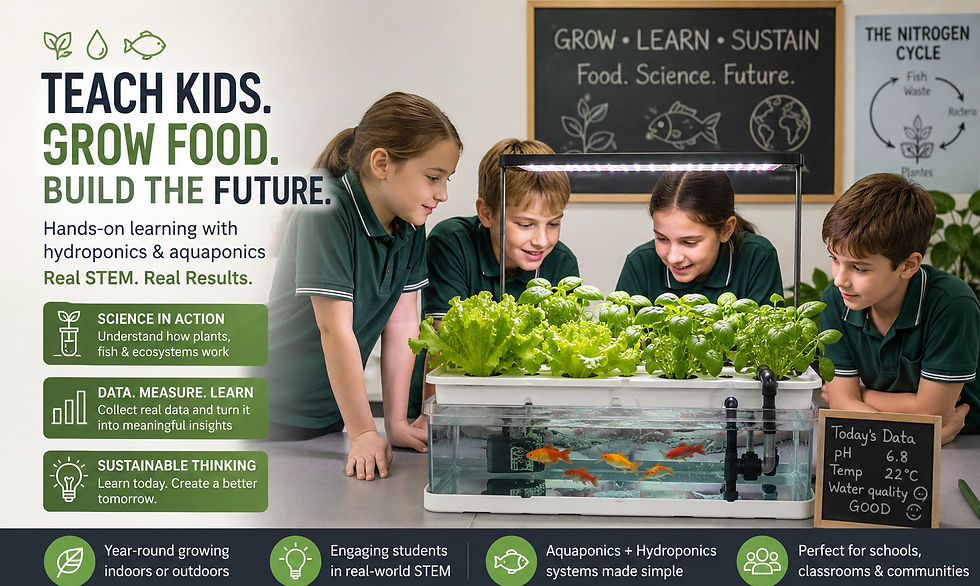
For schools, aquaponics is also one of the most effective ways to teach biology, chemistry, sustainability, food production, ecosystems, water cycles and responsibility through a real working system.
Why Aquaponics Works So Well for Schools
Schools are one of the best environments for aquaponics because students can see the full cycle of food production in front of them. It is not theory sitting in a textbook. It is living science.
A well-designed school aquaponics system can support:
STEM learningSustainability education
Food technology programs
Environmental science
Biology and ecosystems
Water conservation lessons
Hands-on student engagement
School garden and wellbeing programs
The strongest school systems are the ones that are practical, visible and easy to maintain. A complicated system that only one teacher understands is risky. A simple, well-supported system that students can monitor, test and learn from is far more valuable.
That is why Urban Green Farms offers dedicated school-focused aquaponics options, including the Complete STEM School Aquaponic Learning Bundle and the EduGrow Sustainability Learning Bundle – STEM Aquaponics & FoodCube.
These are better suited to schools that want more than a basic fish tank and grow bed. They are designed to become part of a broader learning program.
Best Aquaponics Kit for Schools
For most schools, the best aquaponics kit is not necessarily the cheapest system. It is the system that provides the strongest learning value, is easy to explain, and can be maintained by staff and students without becoming a burden.
Best school option: Complete STEM School Aquaponic Learning Bundle
The Complete STEM School Aquaponic Learning Bundle is the strongest option for schools wanting a serious aquaponics education setup. It gives teachers and students a structured way to explore the relationship between fish, plants, water quality, nutrient cycling and sustainable food production.
This type of system is ideal for:
Primary schools
Secondary schools
STEM programs
Sustainability coordinators
Environmental clubs
Science departments
Kitchen garden programs
Grant-funded school garden projects
For schools applying for sustainability, STEM or garden grants, an aquaponics system also gives the application a stronger practical foundation. Grant assessors generally want to see measurable learning outcomes, student participation and long-term impact. Aquaponics provides all three.
Best premium education option: EduGrow Sustainability Learning Bundle
The EduGrow Sustainability Learning Bundle – STEM Aquaponics & FoodCube is suited to schools that want to combine aquaponics with a broader sustainability and food-growing program.
This is the better choice where the goal is not just to install a system, but to create a visible school sustainability hub.
It is especially useful for schools that want to connect aquaponics with:
Food security
Water conservation
Circular systems
Waste reduction
Regenerative thinking
Hands-on STEM
Outdoor learning
Student-led projects
For schools, the key is not just buying the aquaponics kit. The key is choosing a system that teachers can use repeatedly across subjects and year levels.
Best Aquaponics Kit for Homes
For home growers, the decision is different. Most families do not need a large school learning bundle. They need something practical, attractive, manageable and productive.
The best home aquaponics kit should be:
Easy to understand
Suitable for your available space
Large enough to grow useful produce
Simple to maintain
Expandable if you want to grow more later
Strong enough for Australian outdoor conditions
Best home starter option: Urban Green Aussie Alfresco Aquaponic Kit
The Urban Green Aussie Alfresco Aquaponic Kit is a strong starting point for families and home growers who want to enter aquaponics without overcommitting to a large system immediately.
It suits people who want to:
Start growing food at home
Teach children how food systems work
Grow herbs and leafy greens
Reduce reliance on supermarket produce
Create a productive backyard feature
Learn aquaponics before scaling up
This is the right style of kit for people who are serious enough to want a proper system, but not yet ready for a larger 550L or 1100L aquaponic farm setup.
Best Aquaponics Kit for Backyards
Backyards give you more room to work with, which means you can choose a larger and more productive system. If you want aquaponics to be more than a small learning project, the 550L and 1100L Urban Green Farms aquaponic farm kits are where the conversation becomes more serious.
Best backyard option: 550L Aquaponic Farm - Package One
The 550L Aquaponic Farm - Package One is a strong entry point for backyard growers who want a productive outdoor system without jumping straight into the largest setup.
It is suitable for:
Families
Backyard gardeners
Small-scale food growers
Schools starting with an outdoor system
Community gardens
Sustainability projects
A 550L system gives you enough water volume to create a more stable aquaponic environment compared with very small systems. In aquaponics, stability matters. More water volume generally gives the system more buffering capacity, helping reduce sudden changes in temperature and water quality.
Best expanded backyard option: 550L Aquaponic Farm - Package Two
The 550L Aquaponic Farm - Package Two is better suited to homes, schools and gardeners who want more growing capacity from the beginning. With a 550L fish tank and customisable garden beds, this package is designed for people who want a more complete backyard aquaponics setup.
This option is especially useful if you want to grow:
Leafy greens
HerbsVegetables
Selected fruiting crops
A larger volume of produce over time
It is also a strong choice for schools that want an outdoor aquaponics feature students can observe and maintain throughout the year.
Best Larger Aquaponics Kit: 1100L Aquaponic Farm Kits
For schools, community gardens and more serious backyard growers, the 1100L Aquaponic Farm Kit range offers a larger platform with more growing potential.
Urban Green Farms currently offers multiple 1100L Aquaponic Farm Kit packages, including Package One, Package Two and Package Three.
These systems are better suited to buyers who want:
More growing capacity
A stronger outdoor food-production system
A larger fish tank volume
A scalable aquaponics project
A more visible school or community garden installation
A system that can support broader sustainability goals
The 1100L range is not usually the best first step for someone who only wants a small hobby kit. It is better for committed buyers who already know they want aquaponics to become a serious part of their home, school or community food-growing program.
Which Aquaponics Kit Should You Choose?
Choosing the best aquaponics kit depends on your purpose.
Buyer Type | Best Fit | Why |
Beginner home grower | Urban Green Aussie Alfresco Aquaponic Kit | Simple entry point for learning and growing at home |
Family backyard setup | 550L Aquaponic Farm - Package One | Practical outdoor food-growing system |
Larger backyard setup | 550L Aquaponic Farm - Package Two | More growing capacity and stronger long-term value |
School STEM program | Complete STEM School Aquaponic Learning Bundle | Built for education and curriculum-style learning |
School sustainability hub | EduGrow Sustainability Learning Bundle | Stronger option for grant-funded sustainability projects |
Larger school/community system | 1100L Aquaponic Farm Kits | More capacity and stronger visual impact |
What to Consider Before Buying an Aquaponics Kit
Before buying an aquaponics kit, you should be clear on five things.
1. Who will maintain the system?
For homes, this might be one adult or the whole family. For schools, it should not fall on one teacher alone. The best school systems have shared responsibility across staff, students and maintenance support.
2. Where will the system go?
Aquaponics systems need a practical location with access to water, power and enough space for safe student or family interaction. Outdoor systems should be positioned where they are visible, useful and easy to access.
3. What do you want to grow?
If you only want herbs and leafy greens, a smaller system may be enough. If you want a more productive backyard or school growing system, a 550L or 1100L package is usually a better long-term decision.
4. Is this a learning system or a production system?
A classroom system is mainly about education. A backyard farm kit is more focused on food production. A school sustainability bundle can do both.
5. Do you want to expand later?
If expansion matters, choose a system that can grow with your needs. Urban Green Farms also offers aquaponics accessories, grow media, pumps, plumbing, trays and extension options to help support future upgrades.
Why Buy Aquaponics from Urban Green Farms?
Urban Green Farms is not just an online shop selling random garden products. We specialise in aquaponics, hydroponics, vertical growing, school gardens and sustainable food systems.
That matters because aquaponics is not just a product. It is a living system.
When you buy the right aquaponics kit, you are not just buying a tank and grow bed. You are buying a practical pathway into sustainable food production, water-efficient growing and hands-on learning.
For homes, that means growing fresh food with less mess and less reliance on soil.
For schools, that means turning sustainability into something students can see, test, measure and maintain.
For backyards, that means creating a productive growing system that connects fish, plants and water into one efficient cycle.
Final Recommendation
If you are buying for a school, start with the Complete STEM School Aquaponic Learning Bundle or the EduGrow Sustainability Learning Bundle if you want a broader sustainability program.
If you are buying for a home or family, start with the Urban Green Aussie Alfresco Aquaponic Kit or move into the 550L Aquaponic Farm range if you want a more productive backyard setup.
If you are buying for a serious backyard, school garden or community food project, look at the 1100L Aquaponic Farm Kit range.
The best aquaponics kit is the one that matches your space, your goals and your ability to maintain it. Start with the right system now and you will save yourself the frustration of buying twice later.
Ready to grow food, teach sustainability and build a living ecosystem?
Request a quote or get in touch for advice or more information info@urbangreenfarms.com.au

I found this article while comparing information from a few different websites, and it was one of the easiest to understand. The writer didn't rush into the main topic but instead explained the background first, which made the rest of the article more meaningful. A little later, the discussion focused on 51 club game, and the explanation fit naturally within the overall content. I liked that each section introduced something new instead of repeating the same points. Near the conclusion, 51 club game appeared again with additional details that helped connect everything together. The article maintained a smooth flow from beginning to end and was written in a style that felt informative rather than overly technical.