
Queensland STEM Engagement Grants 2026: Schools Can Apply for Up to $25,000
Queensland schools now have an opportunity to secure up to $25,000 for hands-on science, technology, engineering and mathematics projects through the Queensland STEM Engagement Grants program.
Applications are currently open and close at 4 pm on 29 September 2026.
The grant is open to Queensland state, Catholic and independent schools, making it a genuine opportunity for schools looking to establish or expand practical STEM and sustainability learning.
For schools considering aquaponics, hydroponics, sustainable food production or water-efficiency projects, this grant could provide meaningful financial support. However, the deadline is approaching quickly, and successful applications will need to demonstrate much more than a request to purchase equipment.

What is the Queensland STEM Engagement Grant?
The Queensland STEM Engagement Grants program supports interactive educational activities and projects that increase participation in science and help Queenslanders develop STEM knowledge, scientific literacy and critical-thinking skills.
Grants of up to $25,000, excluding GST, are available for projects delivered over a maximum of 12 months.
Eligible applicants must have:
A Queensland-based business address, office or campus.
An active Australian Business Number.
Public liability insurance of at least $20 million.
An authorised person capable of leading and reporting on the project.
Schools can apply through a teacher. State, Catholic and independent schools are expressly eligible.
The Queensland Government also encourages projects that engage regional and remote communities, First Nations participants, girls and women, disadvantaged groups and people who have historically been underrepresented in STEM.
Can the grant fund aquaponics or hydroponics equipment?
Yes. Grant funding can be used to purchase equipment and technology needed to deliver the proposed STEM project.
However, equipment cannot account for more than 50% of the funding requested. Applications that are solely seeking money to purchase equipment will not be eligible.
For example, a school requesting $20,000 might allocate approximately:
$9,000 toward an aquaponics or hydroponics system and monitoring equipment.
$3,000 toward specialist project delivery and teacher training.
$2,000 toward student experiments, testing materials and consumables.
$2,000 toward educational resources and project documentation.
$2,000 toward student, family and community engagement.
$2,000 toward data collection, evaluation and communicating the results.
The exact budget will depend on the school, project and system selected. The critical point is that the aquaponics or hydroponics equipment must be part of a broader learning program with clear activities and measurable outcomes.
Why aquaponics is such a strong STEM project
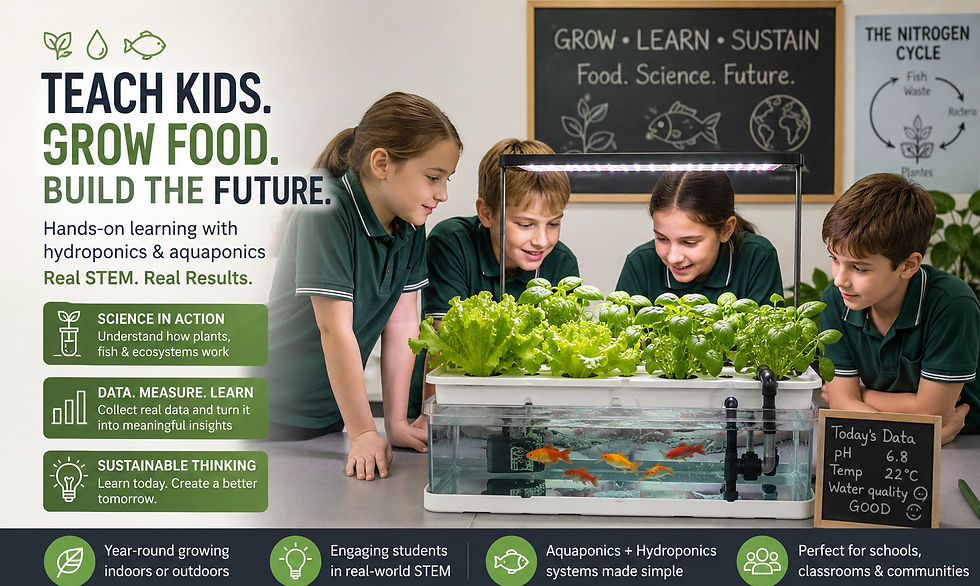
Aquaponics combines fish, plants, water, biology and engineering within one functioning ecosystem.
Fish produce nutrients that support plant growth. Plants and beneficial microorganisms help remove nutrients from the water before it circulates back through the system.
For students, this creates a living laboratory in which STEM concepts are visible, measurable and connected.
Students can investigate:
Fish and plant biology.
Ecosystems and nutrient cycles.
Water chemistry and water conservation.
Pumps, plumbing and system engineering.
pH, temperature, dissolved oxygen and nutrient levels.
Plant growth rates and food yields.
Data collection, graphing and analysis.
Sustainable agriculture and food security.
Resource efficiency and waste reduction.
The relationship between system design and biological performance.
Instead of learning these concepts only through textbooks, students can observe how changes within one part of the system affect everything else.
Hydroponics can also create a powerful STEM laboratory
Hydroponics allows students to grow plants without soil by supplying water and nutrients directly to the root zone.
A hydroponic project could allow students to compare different growing systems, nutrient concentrations, lighting conditions, water consumption, plant varieties or environmental settings.
Students could investigate questions such as:
How does water use in hydroponics compare with a conventional garden?
Which nutrient concentration produces the best plant growth?
How do light duration and intensity affect plant development?
What happens when pH moves outside the preferred range?
Which growing system produces the highest yield per square metre?
Can controlled-environment growing improve local food security?
These are not staged classroom exercises. They are genuine scientific and engineering questions that students can investigate using a functioning growing system.
A grant-ready project concept for schools
A strong application could be built around the following concept:
Closed-Loop Food and Water STEM Laboratory
Students design, operate and evaluate a school-based aquaponics or hydroponics system.
Over the project period, participating students measure plant growth, water consumption, water quality, environmental conditions and food production. They compare their results with conventional growing methods and investigate how controlled systems can produce food using less space and water.
The project could include:
Establishing the aquaponics or hydroponics system.
Training teachers and students to operate it safely.
Developing student research questions and hypotheses.
Monitoring pH, temperature, nutrient levels and water consumption.
Recording plant growth and harvest yields.
Comparing resource use with soil-based growing.
Presenting results to families and the broader school community.
Creating student resources that future classes can continue using.
This positions the system as a long-term STEM learning platform rather than a one-off equipment purchase.
What about primary schools?
Primary schools are eligible, and the learning activities can be adjusted for different year levels.
Younger students could observe plant and fish growth, identify what living things need to survive, measure plants and record changes through photographs or drawings.
Older primary students could monitor pH, temperature and water use, create graphs, compare growing methods and investigate food cycles and sustainability.
A single system can therefore support science, mathematics, design and technologies, sustainability and cross-curricular project learning.
Can independent and Steiner schools apply?
Yes. The Queensland Government states that state, Catholic and independent schools can apply through a teacher.
A Steiner school would generally sit within the independent-school category, provided the applicant meets the organisational requirements.
Aquaponics and hydroponics can align particularly well with experiential and interdisciplinary education because students participate directly in caring for living systems, solving practical problems and understanding the relationship between natural processes and technology.
What about kindergartens and early learning centres?
The program’s broader eligibility rules allow Queensland-based, ABN-registered organisations to apply, but early learning centres are not specifically named in the published school eligibility section.
Kindergartens and childcare providers should contact the grant coordinator and obtain written confirmation before preparing a full application.
A large provider such as Goodstart would probably need to apply through its central legal entity, with the individual centre named as the project location and an authorised employee appointed as project leader.
An early-learning concept could be framed as:
Little Scientists: Exploring Water, Plants and Living Systems
Children could participate in age-appropriate activities involving:
Observing plant and fish growth.
Exploring what plants and animals need to live.
Measuring and conserving water.
Comparing soil and water-based growing.
Recording observations through drawings and photographs.
Involving families in food-growing and sustainability activities.
For eligibility questions, contact the Queensland STEM Engagement Grants team at grantsadministration@detsi.qld.gov.au.
What makes an application competitive?
The strongest applications will clearly explain:
The environmental, educational or community problem being addressed.
Why the project is needed at the school.
How students will participate actively.
Which STEM skills and concepts students will develop.
What students will investigate, measure or create.
How project outcomes will be evaluated.
How the system will continue to be used after the grant ends.
How teachers, families, community partners or STEM professionals will participate.
Why the proposed budget represents value for money.
Applications involving regional communities, First Nations participation, girls in STEM or disadvantaged students should explain this clearly and respectfully.
Schools should avoid submitting an application that reads like a product shopping list. The equipment is important, but the assessors are funding the project and its outcomes.
Urban Green Farms can help with your application
Urban Green Farms works with Australian schools to deliver aquaponics, hydroponics, gardening and sustainable food-production projects.
We can help your school with:
Selecting an appropriate aquaponics or hydroponics system.
Preparing a detailed quotation.
Providing system specifications and technical information.
Developing a grant-ready project concept.
Building a realistic project budget.
Identifying measurable STEM and sustainability outcomes.
Providing curriculum-aligned learning resources.
Supplying water-efficiency and environmental information.
Reviewing your draft application before submission.
Providing supporting information or a letter of support.
Schools can also access our free school grant resources and application-planning templates through the Urban Green Farms Education Hub
If you already have a draft application, you are welcome to send it to Urban Green Farms for review. We can identify gaps, strengthen the aquaponics or hydroponics component and provide the supporting quotation and project information you need.
Do not leave the application until the final week
Applications close at 4 pm on 29 September 2026.
Schools will need time to:
Confirm internal approval.
Select a project and suitable system.
Prepare the budget.
Obtain quotations.
Gather letters of support.
Develop a communications plan.
Complete the application.
Have the final submission reviewed.
The application deadline is strict, and late submissions will not be accepted.
Start your school STEM project today
If your Queensland school has been considering aquaponics, hydroponics or a water-efficient food-growing project, this is one of the strongest current funding opportunities available.
Urban Green Farms can help you move from an initial idea to a properly structured project with the equipment, educational resources and supporting information needed for a competitive grant application.
Contact Urban Green Farms today for a free initial discussion, a tailored system recommendation and a grant quotation.
Email: info@urbangreenfarms.com.au
Urban Green Farms does not administer the Queensland STEM Engagement Grants program and cannot guarantee funding. Eligibility and funding decisions remain with the Queensland Government. Schools and early learning providers should review the official guidelines before applying.


Understanding the difference between home equity and available borrowing power is essential for responsible financial planning. A homeowner might have substantial equity but qualify for a smaller loan because lenders also consider income, credit history, existing debts, and other obligations. Loan-to-value limits and local lending regulations can further affect eligibility. Homeowners should avoid assuming that https://equityrich.ca/ all accumulated equity is accessible as cash. Reviewing personal finances and obtaining estimates from qualified lenders can provide a clearer picture of realistic borrowing opportunities.
Keeping organized records is valuable throughout the life of a home line of credit. Homeowners should retain the original agreement, account statements, payment confirmations, fee schedules, and communications with the lender. Reviewing these documents makes it easier to understand current balances and recognize changes to rates or conditions. Accurate records can also support discussions if an https://everythingmortgages.ca/ unexpected charge or account discrepancy appears. Regular financial reviews encourage responsible borrowing and help homeowners remain aware of their obligations as circumstances change.
Understanding the difference between the draw period and repayment period can help homeowners manage a home line of credit more effectively. During a draw period, borrowers may generally access available funds according to the agreement. Once the repayment phase begins, additional borrowing may become everything mortgages restricted while payments focus on outstanding debt. The transition can affect monthly expenses considerably. Homeowners should know the important dates and expected payment changes before using the credit facility for major purchases.
Healthcare facilities require clear communication between authorized personnel working in different departments. Professional two-way radios may assist with logistical coordination, facilities management, security, and nonclinical operational tasks. Device selection should account for facility policies, possible equipment interference, hygiene requirements, and applicable privacy standards. Radios are not automatically suitable for every clinical environment, so compatibility and approval should be confirmed before use. When appropriately implemented, they can support timely internal https://discounttwo-wayradio.com communication and help operational teams coordinate their responsibilities.
Chemical Suppliers the topic was explained in a way that felt natural and easy to follow. The information is useful, and the writing style makes the content enjoyable to read. I learned a few new things that I had not considered before. Thank you for taking the time to create such a helpful and informative article for readers like me.